Showing posts with label vegetables. Show all posts

Tuesday, July 15, 2008

Growing Vegetables at Sunnyside Farms


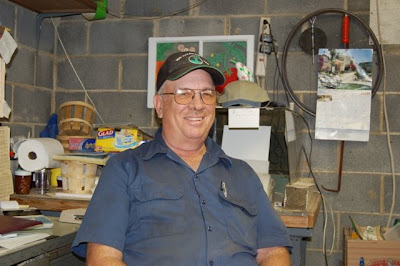
The former owner of Sunnyside Farms is no doubt more famous—haven had his agricultural exploits written up in The Washington Post and The New York Times. But devoted gardeners and those who have an interest in organic food will perhaps be more interested to talk with Nivardo Loya who is in charge of vegetable production at Sunnyside Farms in Rappahannock County. He is the guy who actually does the day-to-day work to grow the vegetables here.


Nivardo came to Sunnyside Farms eight years ago from Chihuahua, Mexico because he had a cousin working here. His wife Lorena might be the only platinum blond from that rural countryside of mestizo peoples. Nivardo and his wife live with their two children Rocio, a student at UVA; and Diana, a 7th grader; and Lorena’s brother in a house located right next to a dozen or so greenhouses. Outside 2 orphaned kittens roll about and play in the yard. In one corner of the yard Nivardo is building a fence to try to keep his remaining 2 chickens alive---the other 40 that he had were eaten by the foxes.


To get to Sunnyside from the town of Little Washington, Virginia turn left on Harris Hollow road. Go a few miles then turn right onto Sunnyside Orchard Lane crossing a bridge that warns heavy trucks “23 tons only”. On this early morning on the left-hand side fog hangs over the nearby mountains. Stop at the first house on the left to ask directions and two men straight out of Deliverance are working without shirts on a broken down car in the front yard. One of them has a huge scar down his stomach. They point the way to the farm house and greenhouses behind the creosote treated fence.


A lot of people in Rappahannock County know about Sunnyside farms for its former owner David Cole was an executive at American On-line who put a lot of money into making his farm a showplace for organic farming . He bought the 425 acre farm to great fanfare in 1996 and sold it to the great disappointment of locals in 2006. The Washington Post characterized the slow retreat of Sunnyside from Rappahannock when they wrote in June of that year, “Speculation concerning the future and possible sale of Sunnyside has increased over the past year as shoppers noticed the dwindling stock at Sunnyside Farms Market on Washington's Gay Street and far fewer produce choices at the FarmFresh Dupont Circle farmers market where Sunnyside is a founding member.”


But all of this talk of business does not interest Nivardo. His interest is strictly agriculture. Standing in one of the dozen or so greenhouses where is it almost too hot to breath Nivardo explains how he farms tomatoes when by definition an “organic” farm is not allowed to use chemical pesticides. Nivardo explains that there are two problems with tomatoes---a virus and a fungus that turn the leaves brown. So to avoid that he plants tomatoes in two different green houses in two different soils. If one patch dies the other should survive. And then he does not replant tomatoes (nor eggplants nor peppers since they are of the same family) in the same soil for 4 years. And to make sure that the fruit gets ripe he pops suckers off the plants, which are shoots which grown yet another shoot.


He also grows eggplants. (Nivardo does not know the Spanish word for “Eggplant” and neither do I so we just call it “Eggplant”.) These are planted in buckets whose bottom has been knocked out. The idea is to raise the plant up a little in the raised beds and give the roots some loose soil into which they can grow. As anyone who has planted eggplants knows their delicate leaves are attacked by leaf hoppers. To stop that Nivardo sprays agricultural soap. And to give them a trellis upon which to grow he runs a string to the top of the greenhouse.


While there are 12 people working at Sunnyside farms Nivardo tends the greenhouse for the most part by himself pulling weeds by hand. The other employees and interns work in the orchard or travel to the farmers markets. Of course when it is raining they help here in the only place where it is not raining.


Nivardo shows off his Super Star onions. These are enormous and they are sweet too like Vidalia. He says last year they sold them for $1.50 but people were willing to pay even more. So this year they raised the price to $3.00 apiece and they are selling fast. The onions are planted so close together that they seemingly have crowded out any possible weeds. They are started indoors from seeds which are planted 3 inches apart. After 7 weeks they are moved to the greenhouse. Asked when he knows to move the onion to the greenhouse he says, “When they are ready I plant them.” meaning he does not need to consult any book.


Each of the greenhouses here is filled with different produce and there are melons and asparagus planted in the fields. Nivardo says he won’t grow any more lettuce this year because in the heat of summer it gets too bitter. Its the same story for cilantro which he says he won’t plant anymore period because it bolts too rapidly and goes to seed.


There is lots of kale planted here although Nivardo admits it tastes better when the whether is cool. Beets are planted at various stages of maturity. There are cut flowers, cucumbers, French radishes and much more that is sold to 30 families who have signed up for the subscription program and to customers at the DuPont Circles Farmers market.


The vegetables grown indoors at Sunnyside are grown in raised beds. Nivardo does not pay too much attention to soil tests but instead prefers to look at the vitality of the plant as a gauge of whether it is growing well or not. He puts down lime to control the PH and adds fish fertilizer and lots of compost but other than that he does not pay much attention to trace elements like boron.


One of the more unique aspects of the greenhouses here is they grow produce year round. Rather than spending thousands of dollars to heat the space inside the greenhouse---heat that would for the most part escape from these walls insulated with only plastic---Sunnyside instead prefers to heat the soil. Outside the greenhouses is a wood and propane fired boiler that pumps hot water into hoses planted throughout the greenhouse soil. Nivardo explains that when the temperature of the air drops below 50 degrees the heating system comes on. The soil temperature is kept warm and Nivardo covers the plants with an agricultural cloth. He says it is brutal work keeping the fire going all the time. He rises at 3 AM every day and during the night to stoke the furnace.


Continue Reading...


Share/Save/Bookmark Sphere: Related Content

Thursday, July 3, 2008

Gardening for God


Before I went to visit Berea Gardens Hartland farm I read Victor Davis Hanson’s “Agrarian Dreams”. This professor of the classics at San Jose State University has become a commentator having been propelled into some notoriety over the immigration debate with his book “Mexifornia”. “Agrarian Dreams” is a memoir of Mr. Hanson’s raisin and plum farm that he tended with his family in the San Fernando Valley in California. After reading this book the first time I wrote Mr. Hanson a fan letter of sorts saying that we both had a lot in common: I too had written on the subject of illegal immigration for a Washington think tank, I too was a grape farmer, and I had been an arm chair scholar enamored with the classics. But then I felt silly because I took a second look at his book and realized it was a deeply sad chronicle of a family’s failed efforts to make a profit with grapes and plums. With the seconding reading the effect was the same as when Lionel Trilling wrote a critique of the poetry of Robert Frost. The “over the hills and through the woods” poetry of Robert Frost he said was not at all cheerful stuff suitable for school age children. Rather it was the melancholy musings of a sad man who actually buried his own son in his back yard and wrote about it in the poem “Home Burial”.


Victor Davis Hanson relates his family’s struggles to make a profit with raisins and plums. He is a conservative yet he blames President Reagan and his department of agriculture for the collapse in raisin prices that drove so many people including Mr. Hanson’s family off of the family farm. His animosity for the secretary of agriculture is like that of Wendell Berry who devotes so much of his ire at Richard Nixon’s Agriculture Secretary Butz who was promoting the idea that the only way that a farm could prosper was to get large. Butz actually wrote that “food is a weapon”.


Mr. Hanson says that while prices for commodities like raisins fell below the price at which they could be grown the middleman who operated cold storage facilities that could keep several acres of fruit chilled were making profits as they always had done. While the farmer was forced to even let his crop rot in the field for lack of a market as the price of raisins full under President Reagan the price in the grocery store remained the same or went higher.


I had bought Mr. Hanson’s book used from Amazon.com and someone had stamped into the cover “discard” as if some library had decided to toss it out. But its theme is current today. Mr. Hanson would be pleased that with the go local, go organic movement family farms are again in vogue and it is now possible to break even with your farm and perhaps even make a profit organic agribusiness notwithstanding


Organic farming is not just a way to grow food for the students and teachers at Hartland College. For these Seventh Day Adventists who are vegans it is a way of live and a part of their religion. These Vegetarians for Jesus operate the Berea Gardens Agricultural Ministries in Virginia where learning to farm is required of every student who graduates from the college.


Bob Gregory is in charge of the greenhouses and farm here having emigrated to Virginia from California 5 years ago where he spent 30 years growing almonds and cut flowers. I could not help but be a bit envious as he stood in his greenhouse showing me beautiful onions, bell peppers, beets, and Swiss chard all varieties I had found difficult to grown in the formerly compacted soils of my own vegetable garden (things have much improved on my own farm since I embraced organic techniques). Male students in jeans and tee shirts and women in skirts worked in the fields hoeing 5 acres of sweet potatoes, egg plants, lettuce, asparagus, and sweet corn. The work here was not just academic—these students and their mentor were saddled with the responsibility of feeding the student body.


Off to the side of the vegetable plots was a large compost pile made of the leftovers from vegetable plants, alfalfa grown for this purpose, and peanut shells hauled in by the truckload from North Carolina. Unlike a lot of organic growers Bob Gregory does not use cow manure for compost because he says that cows could have been giving antibiotics which of course would end up in their manure. Other than that he follows most of the ideas of organic farming but is put off by the rigidity of some of the rules here. He says, “Frankly I disagree with some of the organic standards.” He feels some of the organic standards as stipulated by the USDA do not make much sense. He grows his vegetables “without the use of toxic pesticides. I don’t claim that it’s organic.”


Bob explains agriculture is “part of our faith”. He says, “There are lessons to be learned in the garden that are of a spiritual nature.” Certainly the poet Wendell Berry would agree with that. There is also a practical goal to all this farming which is to teach the students something useful for when they go out and do missionary work in rural areas.


I asked Bob how he controls pests without chemical pesticides. Part of the secret is timing he says. He explains that flea beetles which love the tender leaves of eggplants are a problem for three weeks in the spring. So he times the planting to get the plants established after that first cycle. Beyond that he uses insecticidal soap.


Berea Gardens grow tomatoes indoors to have less problems with fungal diseases like late blight. One of the advantages of growing inside is they can get high enough temperature (135 Fahrenheit) to drive the virus out within a week by closing the windows.


He says root-eating nematodes are a problem in parts of the farm. The control is to let mustard grow for a year. The seeds they drop drive out the nematodes.


The farm here is 6 acres of vegetable gardens and 300 acres of corn and soybeans. Here is where Bob has chosen to be practical rather than dogmatic. He uses the conventional preemergence atrazine to keep the weeds out of his corn. Without that he says there would be more weeds that corn.


Berea Gardens also grow watermelons and blueberries. He says watermelons get lots of viral diseases. Bob rotates by the melons by hand to avoid forming a yellow spot one one side and to keep insects from tunneling in. He puts copper on the blueberries because “A couple of different bacterial attack them.” The other problem here is the obvious one for people on the East Coast and that is Japanese Beetles. He says in one night they trapped 25 pounds of them. He had never seen a problem like this in California and complain they attack everything, even the sweet corn.


Commenting on the difference between dry weather agriculture in California and the rain, heat, humidity, and severe cold of Virginia he says of his students, “If they can grow a successful garden here they can do it anywhere.”


Continue Reading...


Share/Save/Bookmark Sphere: Related Content

Sunday, April 20, 2008

Lois's Produce


I got my chandler strawberry plants from Lois’s produce in the tidewater part of Virginia. They came out beautiful and healthy in the spring a short 6 months after I had planted them in the fall. This is the way the commercial growers do it. Grow them for one short season then rip them out of the ground because they are so prone to disease.

The driveway leading up to Lois’s produce is lined with a ditch on one side and fields of overripe tomatoes on the other. Out front a 1958 rusted Allison Harvester tractor marks the entrance to the farm. Turn left from the driveway and there sits a line of old refrigerated tractor trailer truckers, called “reefers”, a pesticide sprayer, and an old van used to haul produce to the farmers market. The main building here among the tangle of sheds, shacks, and greenhouses was a double wide mobile home trailer. An old blue tick hound land in the sand out front of the office swatting away flies with his tail while an air conditioner hummed audibly.

Inside the office at Lois’s produce Lois Allensworth sits behind her desk. It is covered with bills from the chemical man and farmer’s cooperative. A calendar from 1968 hangs on the wall. The desk is a metal ordinary green desk with a calculator and seed catalogues and technical literature from Virginia Tech, Cornell University, Rutgers, and the University of Maryland. These are schools that provided agricultural extension support to the farmers in the Mid Atlantic Region.

Lois sat back in a chair that squeaked as she turned to the door to face her husband Gary as he walked in the door. He is a tall fellow about 6 feet two with gray hair and weathered skin that has been wrinkled from long days looking up to the sky. Like the clichéd view of long married couple he and his wife looked fairly alike. And like another cliché they looked a little like their dog who raised one lazy ear and eye to see who was coming onto the farm. Bored at what he found, he rolled over and went back to sleep in the lazy sunshine.

The cicadas sang and filled the air on this hazy august day in the Northern Neck region of Orange County. Across the distance lay the Rappahannock River from which Lois irrigated her fields except on years where drought was severe in which the salt from the Chesapeake Bay made the water in the river unsuitable.

Lois and Gary farm 120 acres of vegetables on land that has been in Lois’s family for 4 generations. They sell their produce to a wholesalers association which in turn sells produce to Giant and Safeway grocers. Lois and Gary had built the wholesalers association together with 15 other farmers with a grant obtained from the state.

The vegetables here were grown conventionally where the word “conventional” means “not organic” or what the organic crowd disparagingly calls “chemical farming”. Nothing is wrong with that; it is what the great majority of farmers do. Lois and Gary understand organic agriculture but have opted instead for conventional farming. They have their own opinion of organic farmers. Gary chuckled when he said that, “All organic farmers were down to earth”. Lois questioned their claims saying that produce that was absolutely free of blemishes could not be organically farmed. She said, “Something’s not right it if all looks perfect.”

Lois says she knows no other vocation beyond farming and could think of no other more pleasant way to spend her days. Looking whimsically back at the past she said, “I’ve been doing vegetables all my life because my dad did it. There used to be packing houses all over the northern neck. They’re all gone now.”

While many of their neighbors had giving up on produce in favor of row crops like soybeans and corn or tobacco Lois and Gary continued to earn a generous living with vegetables even if they characterized farming as “warfare”.

Gary talks about growing tomatoes. He said that tomatoes were a boom or bust crop. Some years you made a mint. Other years you left the fruit in the field to rot. He said there was not much advantage anymore in selling vine-ripe tomatoes since they could be shipped from Florida to Washington and Virginia grocery stores in 1 day or from California in 2 days. So he focuses on the canning market picking his tomatoes green. He says, “They’re called mature green.” He says the word “mature” like “matoor”. He explains that these green tomatoes are, “On the verge of maturing.”

Gary explains that lots of big growers pick the fruit even earlier when it is unripe. They put them in a chamber and then apply nitrogen or other gas to make them turn orange so they appear ripe. This produces tasteless, firm tomatoes.

Gary farms his tomatoes using what he calls the “extreme weed” approach which means he uses the hoe, herbicides, and manual labor to keep out the weeds. These means he uses no plastic mulch. Plastic is used to keep weeds out of the crop and to warm the soil to produce an earlier crop. But plastic mulch is expensive and moreover is a point of criticism for the organic and local harvest crowd who criticize the use of this petroleum byproduct. For Gary he steers way from mulch not out of some ideological zeal. Rather is costs too much. He says, “There is a point where you have to determine whether it is worth it. Virginia Tech says it costs $11,516 to plant and harvest one acre tomatoes if you use mulch. For us it is about $6,000 per acre which includes the cost of the fertilizer, the spray program, the stakes, and labor”.

Tomatoes are a labor intensive crop. Each plant is worked like a grape vine---it must be staked and tied and suckers popped off. And an automatic harvesting machine is prohibitively expensive so boxes of tomatoes are harvested by hand.

The tomatoes grown on the farm here are the hybrids so popular with growers and the average buyers. These were cross bred for extended shelf life and reasonable taste but even when picked ripe they do not have the succulent taste of the so-called heirloom varieties whose vines tend to sprawl rather than grown uniform and tall like the beefeater and other varieties. Geneticists have stepped into the debate over what tomato tastes best. One of the first genetically engineered crops was the Flavor-Savor tomato. It was supposed to last longer on the grocer’s shelf and thus be able to be shipped long distances. But it was a financial flop and it did not taste much better than regular hybrid tomatoes and worse it did not even last much longer on the shelf.

Gary plants tomatoes 5 times each season. He tries for 5 crops each season although he adds, “The weather has a lot to say about that.”

Another mainstay at Lois’s produce is sweet corn. Most people do not realize that 95 percent of the corn grown in the USA is not suitable for human consumption. This is called seed corn and it’s grown as feed for cattle and hogs and increasingly to make ethanol. But this corn is tough--kind of like the so-called “Indian corn” that people use to decorate their houses with around thanksgiving.

Sweet corn like strawberries are products of selective breeding and are much different from their genetic ancestors. Much of the corn that people eat is bred and genetically engineered to push the plant to produce lots of sugar. Such technology is not given away for free and so-called “triple sweet varieties” made by companies such as Syngenta are patented.

One problem with growing corn is the number of pests that attack it. Deer love it. Raccoons are perhaps the biggest problem for the backyard gardener. But a bigger menace is a smaller creature: the worm.

Much has been written about so-called genetically engineers Round-Up Ready corn meaning corn that has been genetically engineered with the ability to tolerate the glysophate herbicide. This lets the farmer no-till his soil, thus cutting down on soil erosion, mow down the weeds with mowers or herbicides, sow his feeds, and then spray Round-Up over the top of the plants after the corn gets up a few inches. Because the corn is Round-Up Ready it thrives while the broadleaf weeds and grasses die. Thus the corn is free to grow without competition for water and nutrients---mainly nitrogen---from fescue, morning glories, lambsquarter, pigsweed, and other.

Another type of genetically engineered crop is BT corn. This is corn that is cross bred to include genes from the bacillus thuringiensis or “BT” bacteria. BT is popular with organic farmers so one wonders why the organic farmers are opposed to this type of genetic engineering. BT has been used by farmers worldwide for more than 100 years. It is a bacteria that when consumed by worms literally eats them from inside. The bacteria multiply inside the worm and then eat their way out of their host. So the worm dies.

But BT corn is no panacea. The problem is the worms—corn earn worm and beet army worms--start at the silk of the corn and begin to eat the growing ear. It takes some time for BT to do its magic. The result is the end of the ear of corn is full of holes. Lois says buyers in the grocery store every time will choose the chemically farmed ear of corn which has been sprayed with pesticide because it can be free of any blemishes at all. The organically-grown corn will have had its end gnawed off unless something beside BT is used to protect it.

Gary explain that at, “This time of year [August], the worm pressure in the mid Atlantic, you cannot stop it.” Even with a regular spray schedule once the worm gets down inside the ear of corn the spray does not touch it. So it eats its way to the farmers ruin.

The other difficulties with corn include its thirst for water. Lois says, “You can’t afford to grow corm with irrigation. You cannot afford to grow it without irrigation.” By this she means drought will stop the corn from developing marketable sized ears and the cost of irrigation means you can hardly make a profit. There are two types of irrigation: drip and pivot. Drip means the field is rigged with hoses, regulators, and valves that drip irrigation onto the field until the soil is saturated. But that is done mainly for grapes, strawberries, tomatoes, and other crops. With corn more common is the so-called “pivot”. This is a giant arm that rides on huge tires across the field powered by a diesel engine or three phase electricity. Diesel of course is expensive and three phase electricity is not available in all rural areas. Gary and Lois told a funny story about a farmer who use the pivot. He forgot to watch his equipment and came back the next day to find it had driven itself into the woods.

Gary makes me laugh when she says, “The worst worm to control of all is the beet army worm. I have seen them one time in my life that they came out of a bean field and crossed the highway and there was so many it caused a wreck.” I can attest to that—in my greenhouse they are so thick that the ground is covered with green spots where my son and I have squashed them. These horrible menaces that work in large numbers can defoliate a tomato plan in just a couple of days.

Driving around the farm looking at fields Gary says, “I got a field of tomatoes here that’s nothing but stalk. The tobacco horn worm eat it all up.” He says you can kill a tobacco horn worm with a pesticide called “Warrior”. But if you overuse Warrior or other pesticides you will have a problems with mites because it kills the insects they normally prey on them. “I’ve had it on string beans,” he says.

Like the growers in California Gary and Lois fumigate the soil with a gas called ethyl bromide when they plant strawberries. Farmers are looking for a substitute since ethyl bromide has recently been banned by international treaty since it is blamed for ozone layer depletion. Ethyl bromide Gary says, “Sterilizes the soil. It will control soil born diseases.” He paid someone else $2,400 per acre to apply the chemical. They inject the gas into the soil then put down plastic mulch to hold the gas in place long enough for it to work. They do this for their strawberries saying, “We do plastic culture strawberries which means you plant them in September, you harvest them in the spring, and you destroy them and start over next year for disease control. We grow chandler strawberries.” They buy small plants from a nursery in Virginia that are certified disease free.

Deer are a problem for the strawberry crop. He says least year he put floating row covers on them because the deer were eating them up. The side affect of this was it warmed up the fruit so they were able to bring the fruit to market a bit earlier in April.

I ask Gary about his herbicide spray program. He says he uses something called “Post”. But, “It has a long waiting period for harvest. I also use a fair amount of Dual [and] some Command. You can’t keep it in the field to save your life. So you have to be careful with that stuff.”

His opinion of organic farming is, “If it’s perfectly clean and they say it’s organic they’re pulling your leg. They’ll pay twice as much money for it if it is organic.” He asks, “How organic is it?”

We drive around the farm some more and with each crop we pass Gary explains the problem found in each one. He says he plants cantaloupe in plastic mulch. Sounding stoic he says, “If it rains a lot forget it. If it doesn’t rain and you don’t have irrigation forget it.”

He tried twice to plant cucumbers that year. We have not been able to plant cucumbers this year. I planted them too early. The first crop died. He planted them a second time and then they had a long dry spell and they too died.

Gary tell me that powdery mildew is a major problem in squash. This is a big problem for grape growers as well. Gary says that the vine is almost mature and then the powdery mildew causes the squash to be tapered on the end or discolored. This is why conventional farmers using chemicals---to control such diseases.

Gary says eggplant is a long producing plant and will produce fruit for four to five weeks. So he plants it a couple of times per year to have fruit for a long period of time. This is also true with peppers. The problem with peppers is they get blossom end rot which produces a dark area on the pepper. For that he uses systemic fungicides. He says. “I use Bravo. I don’t have a regular spray program. It’s expensive. If it’s a dry season and you have to irrigate you have less disease pressure but you have more insect pressure. I tend to do it as needed as opposed to a regular schedule.”

I leave the farm with a basketful of elephant garlic to plant in my own garden. Gary and Lois have their garlic laid out on a table in a greenhouse where it is drying. The heat in there is stifling. You plant garlic in the fall and harvest them 220 days later.

I had gone to see Lois and Gary so I could document how conventional farmers use farm chemicals and to compare this with what I was doing with my grape farmer. So when I got home I looked up technical literature on the chemical Warrior that Gary had mentioned.

The literature says the insecticide Warrior contains the synthetic compound pyrethroid which is similar to the natural chemical pyrethrin. Organic farmers use pyrethrin but not pyrethroid since that is manmade which would violate the rules of organic farming. The Warrior product brochure from Syngenta says, “Centuries ago Chinese farmers made an insecticidal powder by grinding up chrysanthemum flower petals, which contained natural pyrethrin insecticides. Scientists isolated pyrethrins in 1910, and synthesized the first pyrethroid—a laboratory analogue of pyrethrins---in 1945.” It is a broad spectrum pesticide meaning it targets most insects including the beneficials. For this reason Syngenta has added a chemical which repels bees. Pyrethrin is rapidly broken down by sunlight so its impact on the environment is slight.

Warrior is a restricted use pesticide which means you need an applicators license to buy it. The product label says “may be fatal if swallowed” as well as “This pesticide is extremely toxic to fish and aquatic organisms and toxic to wildlife.” That’s fairly shocking for something that comes from something that comes from nature. But there are lots of natural products that are toxic like arsenic for example. This is why you have to go beyond the hyperbole to find out what is truly better: organic farming or chemical or some wise combination of the two.

Cornell University is a land grant college or one of the colleges that was founded specifically to assist the farmer. Literature at Cornell hints at the subtle difference between organic and chemical farming. It says, “Piperonyl butoxide (PBO) is a common synthetic synergist that reduces an insect’s ability to detoxify pyrethrum. It is added to most pyrethrum products. Piperonyl butoxide is not allowed under the National Organic Program. Care should be taken not to use pyrethrum products that contain prohibited synergists.” An example of a pyrethrin based pesticide which contains piperonyl butoxide is Raid, which is something almost everyone knows.

Back at my own farm as I write this the Chandler strawberries I got from Gary and Lois have been in the ground now for the second season and are starting to sprout flowers which will produce fruit. At Lois’s produce they would have already been ripped from the ground. But my 100 strawberry plants are just for me and my family. I could care less whether they are blemished by botrytis or disfigured by powdery mildew. But as Gary and Lois point out the consumer is used to perfection. I don’t plan to spray my berries with any chemicals so I expect some rotted fruit. Think of that next time you eat a box of pristine huge strawberries that are grown in the Salinas Valley of California and then trucked across county to your grocer.


Continue Reading...


Share/Save/Bookmark Sphere: Related Content

Sunday, April 6, 2008

Whipple’s Biodynamic Farm

Whipple’s Biodynamic Farm


To make a proper survey of organic farming one needs to look at biodynamic farming for one is an extension of the other. When I first looked at biodynamic farming I was skeptical because some of its ideas are downright wacky. Later I embraced some of its concepts but not all of them.

Biodynamic farming is based on a series of lectures given more than a hundred years ago by Rudolph Steiner. The Austrians were concerned that their farms were losing productivity so they asked Mr. Steiner to take a look at ways to improve soil, plant, and animal fertility. Mr. Steiner in turn took at look at practices that peasants had been using for centuries and put together procedures and developed plant nutrients to harness their experience. The ideas that he developed have been come to known as “biodynamic farming”.

Biodynamic farming is basically the same as organic farming with two added concepts. The first says there is an optimal time to plant seeds or harvest plants based upon the phases of the moon and position of the sun and stars. That the tug of the moon’s gravity exerts an influence on the tides is obvious. But biodynamic farmers believe this gravitational force also has an effect on agriculture. As there are times when the spring tides are high, there is a time when the soil is optimal for cultivation.

The second pillar of biodynamic farming is based upon the use of compost. This is not regular compost used by organic and conventional farmers alike. Rather this compost has been treated with various biodynamic formulations—stinging nettle for silica, valerian to capture cosmic energy--designed to improve plant health. These are buried in the ground in the stomach of a deer and then tossed into a vortex to spin so they can soak up cosmic energy. This is the part of biodynamic farming I found a bit silly. Still I use stinging nettle on my watermelons because watermelons need silica and stinging nettle is loaded with that.

Doug Whipple operates a biodynamic farm only a few miles from my house. So I went to pay him a visit. When I first pulled into Whipple’s Biodynamic Farm I thought the big burly fellow who was working on the mowing deck of a tractor was the hired help. But this scruffy looking fellow was Mr. Whipple himself working in the front yard. His Hungarian wife, Gabriella, was out front cleaning radishes, dill, and red iceberg lettuce for delivery to customers that had enrolled in the Whipple’s CSA (community supported agriculture) program as subscribers. Their tiny daughter Lilly was running around the yard completely naked except for chocolate stains all over her face.

Doug is an attorney who spent nine years working in Germany which is presumably where he met Gabriella, a brown eyed European beauty with a French accent. When I saw his giant house whose living room, my son pointed out, was bigger than my own house I thought his must be another hobby farmer playing at agriculture. But as I got to know Doug Whipple I learned that he was serious about his craft. His healthy heirloom vegetables are a testament to his skill in the garden.

We walked down the hill to his vegetable farm, past the young oak trees whose roots were inoculated with truffle spores, past the irrigation pond, and past the barn where the farm intern worked, and down to his garden of sweet corn, tomatoes, eggplants, beans, radishes, beets, carrots, lettuce, tomatillos, and beans.

Here in the middle of whitetail deer country there was no electric deer exclusion fence. Doug explains that they use the recording of a mountain lion in lieu of a deer fence. Gabrielle laments that, “It does not work for rabbits”.

I asked Doug questions about plant disease problems since organic farmers do not use chemical pesticide to control them. Doug explained that tomatoes have problems with ring spot and tobacco mosaic virus. As for other maladies, he says he takes care not to water them much because that makes fungal problems worse. He said that pepper plants are susceptible to leaf spot which is a bacterium. Other problems include anthracnose which is a problem for corn and grape growers as well. Asked about his pest and fungicide control program he says, “I try and do nothing”.

Doug says the goal with biodynamically grown vegetables is to make them healthy so that they can use their own defenses to ward off disease and pests. He says “Biodynamic farms make healthy plants” and counsels to “avoid conditions that create fungus”.

He says late blight is a big problem on tomatoes and “can wipe them out”. For that he uses copper and hydrogen peroxide which are both listed as organic. He buys foliar sprays from Peaceful Valley to raise the brix (sugar level) in plants. He also sprays epsom salts onto his crops to raise the level of magnesium. I use epsom salts as well in the vineyard.

Most of the problems he has are insect related. He says, “If a plant gets stressed, aphids come in. We spray them with dish washing soap.” For flea beetles—which chew tiny holes in the foliage—he uses neem oil which comes from a tree grown in India. Explaining his pest control strategy he says, “A lot of it is in the seed you buy”. He collects these seeds from plants and uses them again the next year. That is one of the principles of biodynamics. Conventional farmers know that as well. On my farm I replant elephant garlic because the plants are supposed to be able adapt to the local conditions.

I have always found it interesting that each vegetable has its own pest often named for the plant on which they live. So it is with the Colorado potato beetle which feeds on, obviously, the leaves of potato plants. It looks like a lady beetle except it has stripes. To control these you can see one reason why organic produce is more expensive than produce which is conventionally grown. Doug protects his potato plants with floating row covers which are kind of spun cotton tents tossed over each row of plants—they are so light that they literally float above the plants. These keep out pests but are obviously expensive. They also protect plants against frost damage down to 27 degrees Fahrenheit which is an added benefit.

The farm here is crisscrossed with irrigation hoses that Doug and his intern move around all day long. It is especially important for the many varieties of lettuce grown here which Doug says need watering every day least they turn bitter. The irrigation system is gravity fed from a pond.

For weed control he uses paper and plastic mulch. Since plastic is made from the petroleum—petroleum is the target of ire for organic farmers--Doug prefers to use 3 foot wide craft paper and straw. He puts down mulch and then pokes a hole for the seed. He uses a mulch layer machine to apply the mulch and bury the edges in dirt.

Doug plants seeds per the biodynamic calendar spelled out in the Stella Natura Agricultural Planting Guide and Calendar. He says,” Organic is the beginning of biodynamic. Biodynamics is about growing food that gives humans more of the vitality they need. In a biodynamic farm you are looking at the whole system.”

After sampling his produce you would agree with his sentiment that the grocery store food is so bad he can hardly eat in anymore. Doug would like to see such quality produce available for ordinary people. “What they buy in the grocery store and what they want should be the same.” As for himself, “So many things now I cannot eat in the grocery store because they taste bad for me.”

Doug also does not like grocery store milk for it is pasteurized. (Pasteurized milk is heated to 150 degrees for a few minutes to kill off any bacteria. Some say this kills of flavor and nutrients too.) Milk which is not pasteurized is called “raw milk”. In Virginia it is illegal to sell raw milk so Doug has bought shares in a dairy cow. Raw milk cheese is available in Europe and Canada and in pricey grocery stores like Dean and Deluca.

For insect control Doug plants buckwheat whose flowers attract beneficial insects like aphid-eating lady bugs. He says they soak up phosphorous from the soil which is turned back into the ground when you till it in. For cover crops he uses winter rye and winter peas. Winter peas put 200 pounds of nitrogen in the soil per acre if you till them in when they flower in May. For fertilizer uses a blend of kelp and ground up fish. I find that winter rye is good because you can dig a row right into the grass and then plant young plants thus having instant mulch. But winter rye inhibits germination of seeds so know that if you plan to use it.

At Whipple Farm tomatillo is grown on trellises consisting of two strings tied between stakes. This like the heirloom tomatoes he grows have a much better taste than the hybrid tomatoes sold in the grocery store whose main redeeming value, say the critics, is they can survive the long trek from Florida and California farms to the East coast. He also grows a form of artichoke called “cardoon”. Farmers who grow heirloom vegetables says growers have a responsibility to these living bits of history for if there seeds are not handed down from one generation to the next they would become extinct. This is why they are called “heirlooms”. Heirloom tomatoes often have odd shape and color but they have decidedly superior flavor.

Doug wraps up his interview with me in an email whose eloquence does not need editing:

“As for fungicides, pesticides, they are used when needed on our farm. The goal is to get the plant healthy enough to not need them, and each year we get closer. My basics for farming are Serenade Max and H2O2 for fungus (separately, not together; H2O2 also increases the effectiveness of just about anything and is also mixed with my nutritive foliar sprays since it assist the plants in absorbing the nutrients), and Serenade is used with fish oil as a sticker; the fish oil is good for the plant. We’ve got some early blight in our tomatoes right now, and I’m spraying them with Serenade this week, and H202 next week.

“For insect problems, I use Dipel for worms, also with the sticker. If we have a severe outbreak of flea beetles, or potato beetles then I hit them with a combo of Rotenone, dish soap, H2O2, and Diatomaceous earth. I don’t like using Rotenone, since it’s broad spectrum, but it’s the only thing that works fast. Mixing with the H2O2 means I only have to use about half the recommended dosage.

“Finally, the worst critters are the squash bugs. They destroy the Zucchini and mark up the tomatoes. And they are very difficult to kill. For them, I use the same thing as for flea beetles, but with less Rotenone, more diatomaceous earth, and more H202.

“With vegetables, late blight is rarely a problem unless you have a really wet warm season. Late blight can wipe you out quickly. I truly believe that if you get the organic matter in your soil up using compost and green manures, you will avoid many of these issues because high organic matter content soils can take extremes in weather much better. I can literally see the improvement in our soil each year.

“I call myself still in transition (from organic to biodynamic; we’ve never been conventional), since I’m not yet to the point where I can completely dispense with these things. Even if you get to that point, your plants can still get stressed by weather, and then you’ve got to have some tools to deal with it. Of course, I also use the biodynamic sprays for stressed plants. We will use the horse nettle and horn silica in the next two weeks. I’ve not yet tried the biodynamic remedies for insects, simply because I’d rather get my plants healthy. For now, the insects and diseases tell me things, so I want to hear what they have to say. I can see which varieties have weaknesses (e.g., the hornworm has only shown up on two types of tomatoes so far and only about half of the tomato varieties are showing signs of blight). So my goal will be to strengthen the seed for next year, and to continue to improve the relations between soil, plant and sky. While growing biodynamically should also improve seed stock, there are ways of preserving the seed using biodynamic preparations that should strengthen the seed even more.

“I’m really going to try to strengthen potato seed stock. Potatoes have so many problems because of how they’ve been treated in the past couple hundred years. I’m going to see if I can start reversing some of that. I just had some of our potatoes for lunch. Very tasty.”


Continue Reading...


Share/Save/Bookmark Sphere: Related Content